General
Why Early Science Education Matters: What the Research Tells Parents About Ages 5–8
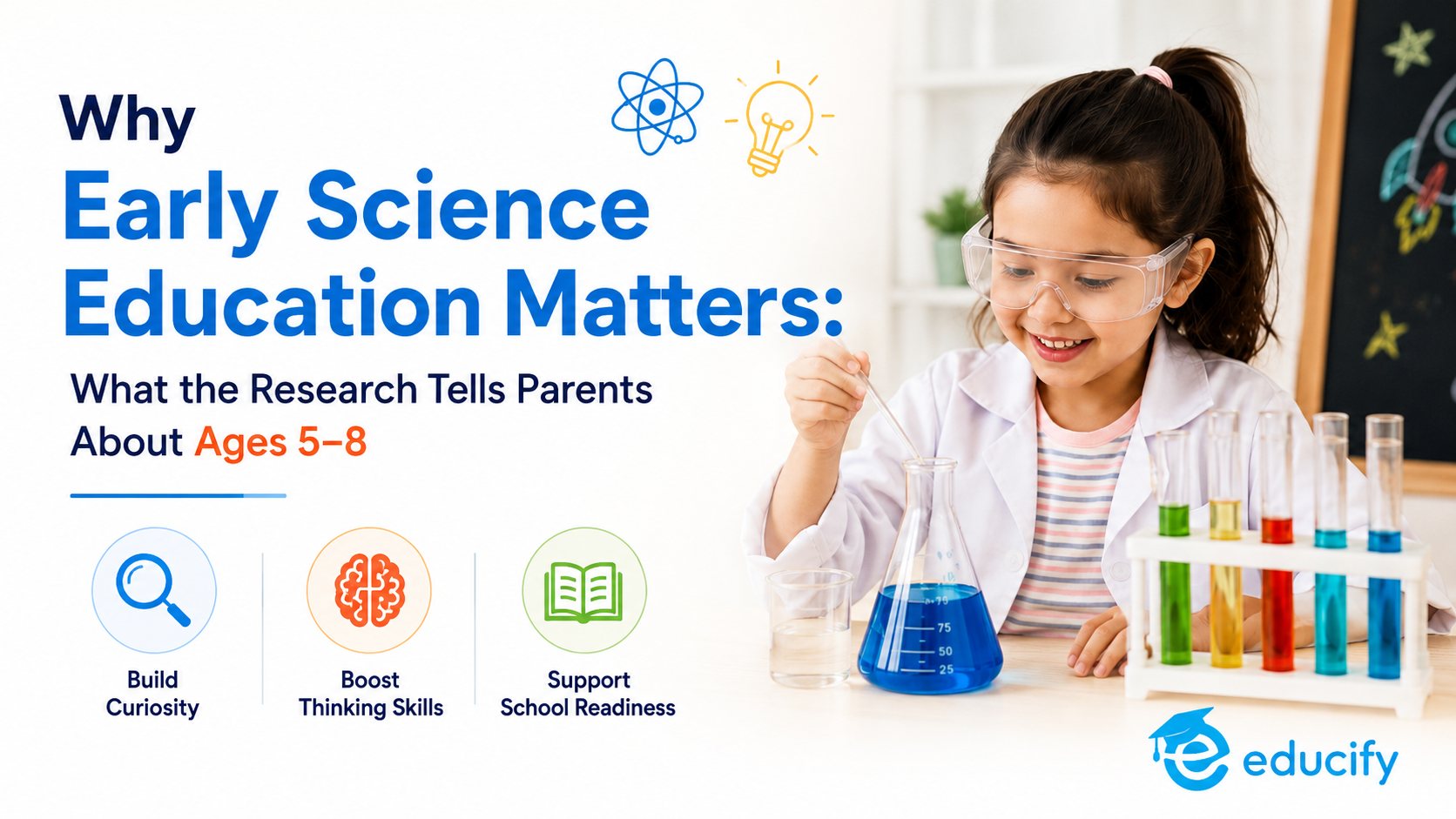
By the time most children turn nine, their attitudes toward science have largely been set — for life. This isn't a marketing claim. It's the consistent finding of more than two decades of educational research, including longitudinal work from the OECD, the National Science Foundation, and developmental psychologists at Harvard, Stanford, and the University of Michigan.
For parents of children ages five to eight, that finding has a clear implication: the early elementary years are not a warm-up for science learning. They are the foundation. What happens during this window predicts everything from middle-school course selection to long-term confidence with quantitative thinking.
Here is what the evidence actually says, and what it means for the choices parents are making right now.
The neurological case for starting early
Between the ages of five and eight, the human brain undergoes one of its most rapid periods of synaptic refinement. The prefrontal cortex — the seat of reasoning, planning, and hypothesis-testing — is being shaped by everyday experience at a rate that will not be matched again until adolescence.
When children at this age engage in genuine scientific thinking — observing, predicting, testing, revising — they are not merely "learning science." They are building the neural architecture for analytical reasoning itself. Studies in developmental neuroscience have shown that early exposure to inquiry-based learning produces measurable, durable improvements in executive function, working memory, and attention regulation.
The implication is uncomfortable for parents who assume science can wait. The cognitive habits being formed during these years will be far harder to install later.
Identity forms before content
Long before a child can define what a hypothesis is, they have already decided whether science is "for them." Research by Andrew Shtulman, Susan Carey, and others has demonstrated that children begin developing a science identity as early as age five. By age seven, most children can articulate whether they think of themselves as "good at science" — and these self-assessments are remarkably predictive of future performance.
The mechanism is well-documented. Children who receive early positive experiences with scientific inquiry come to see themselves as people who do science. Children who don't, internalize the opposite. The content gap is recoverable. The identity gap is not, at least not easily.
This is why programs that delay meaningful science instruction until third or fourth grade — common in many U.S. school districts — are working against the developmental grain. By that point, identity has already calcified for a substantial portion of students.
The myth of "too young for real science"
A persistent misconception among parents is that children ages five to eight are too young for "real" science — that this stage is for crafts, songs, and rote facts, with the actual thinking happening later.
The research is unambiguous on this point: children in this age range are fully capable of engaging in authentic scientific reasoning when given appropriate scaffolding. They can form hypotheses, design simple experiments, interpret evidence, and revise their thinking based on results. The work of cognitive scientist Alison Gopnik has shown that preschool-aged children naturally use Bayesian reasoning — updating their beliefs based on probabilistic evidence — long before they can explain what they're doing.
What young children cannot do well is sit through lectures. The mistake is not teaching them science too early; it is teaching them science the same way we teach older students.
What strong early science learning actually looks like
Decades of efficacy research converge on a small number of features that distinguish high-impact early science instruction from low-impact instruction. Parents should look for:
- Inquiry over recitation. Children should be asking questions and testing answers, not memorizing terminology.
- Hands-on materials. Manipulating real objects — magnifying glasses, magnets, water, plants, simple circuits — produces dramatically better outcomes than worksheet-based learning.
- Productive struggle. Children should occasionally encounter problems they cannot immediately solve. Brief, supported difficulty is where learning consolidates.
- Cross-disciplinary integration. STEM at this age is most effective when it overlaps with reading, drawing, and storytelling rather than being walled off as a separate subject.
- Adult engagement. A knowledgeable adult who can ask the right follow-up question is the single highest-leverage variable in early science learning.
If a child's current science instruction does not include most of these elements, supplementation is warranted.
The long-term economic and civic argument
Beyond individual development, there is a societal dimension parents should understand. The OECD's PISA assessments have consistently shown that countries with stronger early science instruction produce adults who are more capable not only in STEM fields but in evaluating evidence across every domain — from health decisions to financial choices to civic judgment.
In an information environment increasingly characterized by misinformation, the capacity to reason from evidence is no longer a specialist skill. It is a baseline requirement for functional adulthood. That capacity is built or foreclosed in the years parents are navigating right now.
What parents can do
The strongest predictor of a child's science trajectory is not their school. It is whether the adults around them treat questions as worth pursuing. Three specific actions are supported by the evidence:
Answer "why" questions seriously.
When a five-year-old asks why the sky is blue or why ice floats, the answer matters less than the modeling of inquiry. Look it up together. Provide one or two hours of supplementary science instruction per week. Studies of early enrichment programs consistently show measurable gains at this dosage.
Choose a qualified instructor.
Generalists can do harm by teaching science incorrectly or unenthusiastically. A specialist tutor — even for short sessions — outperforms longer unspecialized exposure.
Start now
The developmental window for foundational science learning is open. It does not stay open indefinitely. Parents who act during the early elementary years are working with the grain of their child's neurological development; parents who wait are working against it.
Find a qualified science tutor matched to your child's age and curiosity level. Science is fun on Educify— browse vetted educators who specialize in early elementary STEM, and book a first session this week.
The most important science lesson your child will ever take is the next one.
Ready for one-on-one help? Book a free trial lesson or browse our science tutors.


